Bacon Banter
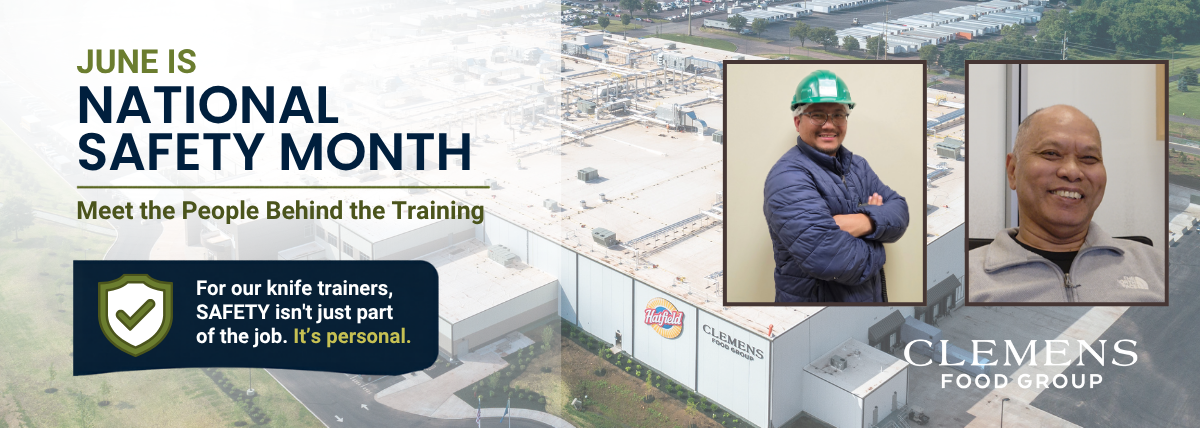
United StatesJune is National Safety Month: Meet the People Behind the Training
For knife trainers, safety isn't just part of the job. It's personal.

When Biak Hmung arrived at Clemens Food Group more than nine years ago, Clemens Food Group’s Coldwater, Mich., plant was still a new pork production facility. New Team Members were coming through the doors every day, and training wasn't just important—it was essential.
For Biak, that environment felt like a natural fit.
"I like showing people how to do the job and coaching them," he said. "Everyone who comes here, we want to help them be successful."
Today, Biak serves as a Knife Training Supervisor in Coldwater, helping Team Members learn one of the most important skills in a processing facility: how to safely use the tool they'll rely on every day.
A few hundred miles away in Hatfield, Pa., Knife Training Supervisor Phanny Nhek has been teaching those same lessons for most of his career.
Phanny has worked in meat processing for more than 30 years and has been training employees since 1995. Long before structured onboarding programs became common, he watched new employees learn through trial and errors, sometimes with painful consequences.
"I've seen a lot of injuries from people not having proper training," he said.
That's one reason National Safety Month resonates with both men.
Widget title goes here.
Building a Culture of Safety
Neither talks much about statistics or programs. Instead, they talk about people. The new Team Member who's nervous on their first day. The employee who's never used a knife professionally before. The person who just needs someone patient enough to slow down, answer questions and help them build confidence.
For both trainers, that's where safety starts.
If there's one thing both trainers have learned over the years, it's that safety isn't something people master in a day. "New Team Members don't pick up everything right away," Biak said. "It takes time."
That's especially true when the job involves a knife.
In a processing facility, knives are one of the most commonly used tools on the floor. Many Team Members use them throughout their shifts, day after day. A dull blade, poor technique or a moment of distraction can quickly become a problem.
But when Biak talks about knife safety, he talks about preparation. Showing up on time. Having the right PPE. Making sure a knife is sharp before using it. Paying attention to what's happening around you.
"It's about protecting people," he said simply.
Phanny sees it much the same way.
Over three decades in the industry, he's watched training evolve. When he first started, new employees were often paired with another worker and expected to learn as they went.
Today, new Team Members receive structured training before they ever begin making cuts.
"You see a lot of improvement," Phanny said. "Now they know about the safety around knives before they even start. It helps them feel more comfortable."That confidence doesn't happen overnight. Some people pick up a knife and quickly understand the movements. Others need more practice. More repetition. More encouragement.
"People are different," Phanny said. "Some take a little longer to get used to it."
That's where patience comes in. Both men talked about the importance of meeting Team Members where they are. Different backgrounds. Different languages. Different experiences. The goal isn't simply teaching someone how to make a cut. It's helping them develop habits that will keep them safe for years to come.
And sometimes, the biggest lesson is learning not to rush.
"When you first start, you're nervous," Phanny said. "You're still learning. The speed will come."
It's advice that applies far beyond knife training.
As National Safety Month reminds us, safety is built one decision at a time. One conversation. One coaching moment. One Team Member willing to slow down and do things the right way.
At Clemens, we often say that safety is how we care for our people. For Biak and Phanny, those words carry real meaning.
For Biak, the reason behind that commitment is easy to explain. "We all have a family to protect," he said. “Our goal is making sure everyone goes home the same way they arrived.”
It's a thought that follows him long after the workday ends.
Because the goal of safety isn't just avoiding an injury report or reaching a milestone. It's making sure people can do their jobs successfully, provide for their families and return home at the end of the day. Every safe habit, every coaching conversation and every training session contributes to that goal.
That's what motivates Biak. It's what has kept Phanny teaching for more than 30 years.
And it's why, every day, they continue helping the next Team Member get a safer start than they had themselves.
For anyone considering a career at Clemens Food Group, the stories of Biak and Phanny reflect something you'll find across our organization: a commitment to people.
From day one, Team Members are supported by experienced coworkers and trainers who want them to learn, grow and work safely. It's a culture built on patience, respect and a shared responsibility for one another's well-being. Because when people feel supported, they can do their best work—and return home safely to their families every day.